 English
 日本
日本 한국인
한국인 Français
 Deutsch
 español
 Italiano
 Portugal
 Việt Nam
 türkiye
 عرب
عرب Русский
 čeština
 แบบไทย
 Eesti
Eesti Gaeilge
 Hmoob
Hmoob íslenskur
 Cymraeg
 български
 اردو
اردو Polski
 Hrvatski
 українська
 bosanski
 فارسی
فارسی lietuvių
 latviski
 עִברִית
 Română
 Ελληνικά
 dansk
dansk Magyar
 norsk
norsk Suomalainen
 Nederlands
 svenska
 slovenský
 Slovenščina
 हिंदी
हिंदी Indonesia
 Melayu
 Malti
Malti Kreyòl ayisyen
 català
 বাংলা
বাংলা Српски
 o'zbek

What is a Rotary Drum Dewaterer?
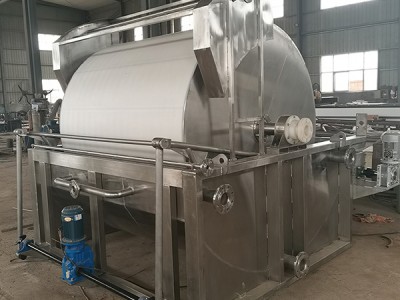
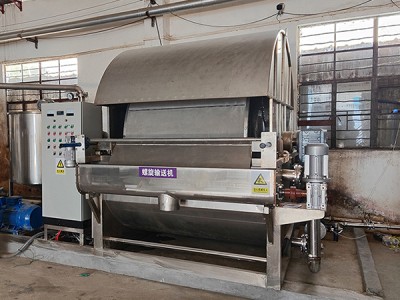
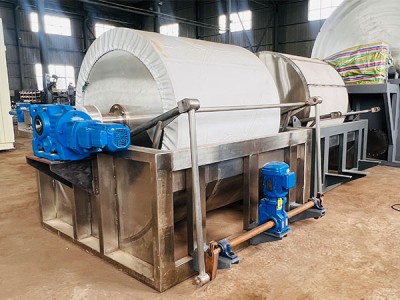
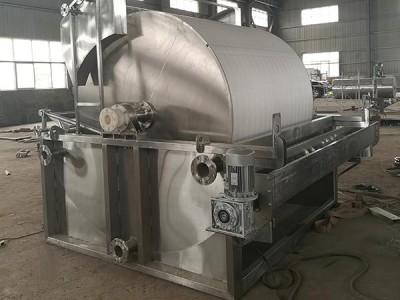
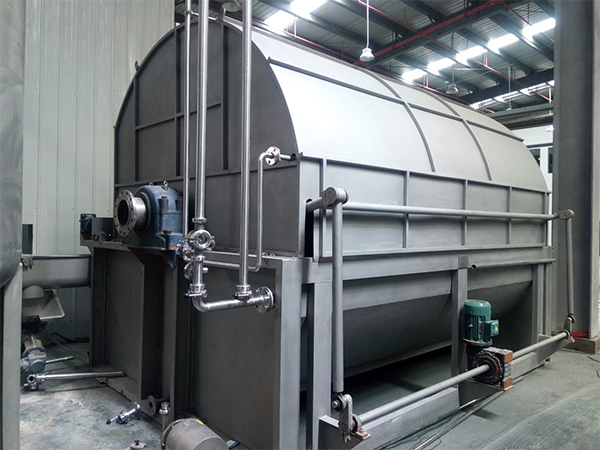
A rotary drum dewaterer is one of the core types of traditional continuous solid-liquid separation equipment, falling into the category of negative pressure filtration machinery. Its main component is a horizontal rotating drum covered with filter media on the surface. The drum interior is divided into multiple independent vacuum chambers. Together with auxiliary components including a trough, vacuum system, discharge unit, cleaning system and drive system, it forms a complete filtration and dewatering unit.
Unlike plate and frame filters that operate intermittently, the rotary drum dewaterer features fully continuous and automatic operation throughout the process. Powered by vacuum negative pressure, the equipment draws liquid from suspended slurry through the filter media, while solid particles are trapped on the filter cloth to form filter cakes. This achieves solid-liquid separation and material dewatering, making it a versatile and well-established machine widely used in industrial wet processing applications.
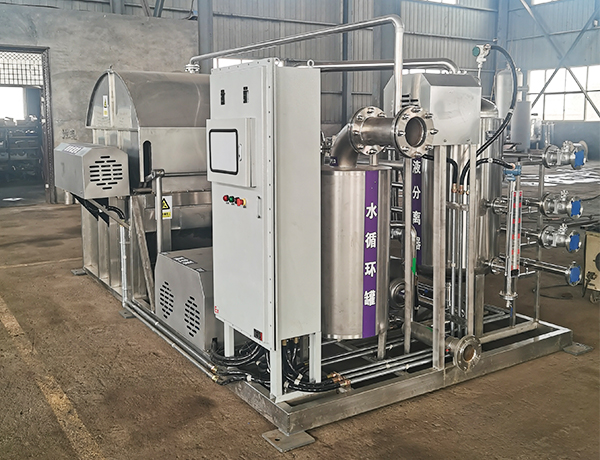
Working Principle and Operation Process of Rotary Drum Dewaterer
The rotary drum dewaterer operates continuously and cyclically via the constant rotation of the drum combined with the vacuum system. The entire process consists of five automated stages to complete the full solid-liquid separation.
Slurry Adsorption & Filtration Zone
The lower section of the drum is submerged in slurry. A negative vacuum pressure is generated inside the drum chambers. Driven by pressure difference, filtrate passes through the filter cloth and flows into the vacuum separation tank, while solid particles are retained on the cloth to form primary filter cakes, completing the initial solid-liquid separation.
01
Filter Cake Dewatering Zone
As the drum carries the cakes out of the slurry level, vacuum pressure is maintained continuously. Air penetrates the gaps inside the filter cakes and removes free moisture, which greatly reduces the cake moisture content and achieves deep dewatering.
02
Filter Cake Washing Zone
For applications requiring high material purity, spray devices can be installed to rinse filter cakes with clean water or solvent. This removes residual mother liquor and contaminants to improve material purity, and all washing liquid is collected by the vacuum system.
03
Filter Cake Discharge Zone
When filter cakes rotate to the discharge position, vacuum is cut off and the chambers switch to atmospheric pressure or slight positive pressure. The cakes lose adhesion and are automatically stripped off by discharge components such as scrapers and belt diverters for material discharge.
04
Filter Cloth Regeneration & Cleaning Zone
After discharge, the filter cloth is backwashed with high-pressure water to thoroughly clear fine particles trapped in mesh holes. This restores the permeability of the filter cloth, ensuring stable long-term filtration and reliable equipment operation.
05
(1) Core Advantages
High level of automation
The unit supports one-button start and stop with fully automatic cyclic operation. Only regular inspections are required, which greatly reduces labor intensity.
Stable operation and low failure rate
It features a simple and proven mechanical structure without complex high-pressure transmission parts. With strong adaptability to diverse working conditions, the equipment can run continuously and reliably for a long time.
Excellent filter cloth regeneration
Equipped with a high-pressure backwashing system, it effectively unclogs mesh holes and prevents blockage. This maintains stable filtration efficiency and extends the service life of filter cloth.
Wide material adaptability
It handles various complex slurries including fine particles, high-viscosity materials and low-concentration mixtures. The thickness and moisture content of filter cakes can be flexibly adjusted to meet different process requirements.
Compact footprint and high integration
Adopting an all-in-one integrated design, it requires no complicated civil engineering work. Easy to install, it fits well with various workshop layouts.
Classified by discharge method and structural differences, rotary drum dewaterers fall into two main categories, catering to full-range working conditions such as general applications, viscous materials, fine purification and light-weight materials.
Scraper Type Vacuum Rotary Drum Filter
It adopts rear or bottom feeding, combined with scraper discharge and auxiliary discharge via compressed air back-blowing. Featuring a simple structure, low failure rate and easy maintenance, this model is suitable for granular slurries with moderate hardness, easy release and low viscosity. It is widely used for dewatering in mine tailings, general chemical processing, coal washing and other conventional scenarios, and delivers outstanding cost performance for industrial mass production.
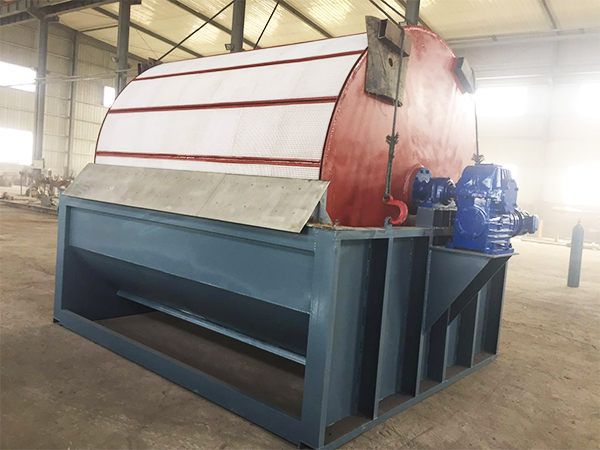
Pre-coat Vacuum Rotary Drum Filter
Matched with the pre-coat filter aid process, it forms a uniform filtering layer. Designed for ultra-fine particles, low-concentration materials and substances prone to filter cloth clogging, it can efficiently trap fine contaminants. This equipment is mainly applied to high-precision solid-liquid separation and material purification for fermentation broth, pharmaceutical slurry, food and beverages, with far superior filtration accuracy compared with standard models.
Core Functions
The rotary drum dewaterer is primarily used for solid-liquid separation, dewatering, washing and purification of various suspended slurries, as well as filtrate purification and recovery. It enables the collection of dried solid materials and the recycling of purified filtrate, realizing the dual utilization of materials and water resources while meeting production and environmental protection requirements.
Major Application Industries
Lorem ipsum dolor sit amet consectetur adipisicing elit.
Mining and Metallurgy
It performs dewatering and separation on tailings slurry, mineral powder slurry and metallurgical liquor. The equipment recovers mineral materials, purifies tailings wastewater and reduces the moisture content of tailings, facilitating tailings stockpiling and resource recycling.
Chemical Industry
It is applicable to the filtration and dewatering of slurries containing inorganic salts, pigments, fillers, chemical fertilizers and other chemical materials. On-stream washing removes impurities to improve the purity of finished chemical products. Meanwhile, chemical mother liquor is recycled to cut raw material costs.
Food and Pharmaceutical Industry
It handles solid-liquid separation for starch, sucrose, fermentation broth, traditional Chinese medicine slurry and more. The mild vacuum filtration process will not alter material properties, ensuring the quality and safety of food and pharmaceutical products.
Environmental Protection & Wastewater Treatment
It dewaters and reduces the volume of biological sludge, chemical wastewater sludge and white water sludge from papermaking. The moisture content and overall volume of sludge are greatly lowered, which reduces subsequent sludge disposal costs. It serves as key equipment for terminal wastewater treatment.
Papermaking Industry
It realizes pulp dewatering and white water recovery by separating pulp fibers from wastewater. Reusable fibers are recycled to improve raw material utilization rate, and production wastewater is purified for cyclic use.
Coal Industry
It dewaters and recovers coal washing slurry and coal slime to produce clean coal slime products and boost the utilization rate of coal resources. It also addresses the problem of turbid and hard-to-treat coal washing wastewater.
Standard routine maintenance is essential to ensure the long-term efficient operation and extend the service life of rotary drum dewaterers. The key maintenance work falls into three categories: daily inspection, periodic maintenance and component upkeep.
Daily Inspection & Maintenance
Check that the equipment runs at a steady speed with no abnormal noise or vibration. Monitor the vacuum system to ensure stable pressure without air leakage or pressure drop. Inspect the filter cloth for deviation, damage or clogging. Verify normal water pressure of the spray cleaning system and unblocked nozzles, and confirm flexible movement of the discharge mechanism. Remove residual materials from the trough to prevent sedimentation and caking that may compromise filtration performance.
Periodic Comprehensive Maintenance
Drain and clean vacuum pipelines and separation tanks every week to avoid pipeline blockage caused by accumulated contaminants. Check the oil level and quality of lubricant in drive motors and reducers monthly, and top up or replace lubricant in a timely manner for smooth transmission. Examine wear conditions of discharge parts including scrapers, steel wires and belt diverters, and adjust gaps to achieve complete cake discharge. Calibrate vacuum level and rotating speed parameters to maintain operational accuracy.
Maintenance and Replacement of Core Components
Filter cloth is a wearing part and shall be replaced regularly according to material abrasion. Adjust its tension after replacement to prevent deviation and wrinkling. Vacuum seals tend to age and leak after long-term operation; inspect and replace them every six months to one year to maintain stable negative pressure. Carry out regular checks on small parts such as nozzles, bearings and drive chains, and replace them once worn.
Maintenance During Shutdown
Before long-term shutdown, thoroughly clean residual slurry inside the filter cloth, trough and pipelines to prevent material from drying out, corroding the equipment or clogging filter holes. Cut off power and air supply after shutdown, and apply anti-rust treatment on exposed metal parts to avoid rust and damage.
FAQ
What are the differences between rotary drum dewaterers and conventional filter presses?
+
-
The core distinctions lie in operation mode and filtration power. Rotary drum dewaterers adopt continuous vacuum negative pressure filtration and operate fully automatically without interruption. They deliver evenly dewatered filter cakes and support on-line washing, making them ideal for large-scale production.
By contrast, filter presses rely on mechanical high-pressure squeezing and work intermittently. They require frequent manual assistance for material loading and unloading. Though they achieve lower moisture content per batch, continuous production is not feasible, so they are better suited for small-batch applications demanding superior dewatering results.
What causes excessively high moisture content of filter cakes during operation?
+
-
Common causes include insufficient vacuum degree, air leakage in pipelines, excessive drum rotating speed leading to inadequate dewatering time, clogged filter cloth with poor air and water permeability, as well as overly dilute slurry and ultra-fine material particles.
Corresponding solutions are to inspect seals, raise vacuum level, reduce rotating speed, and clean or replace the filter cloth.
How to solve incomplete filter cake discharge and excessive residue?
+
-
First, check for wear and excessive gaps on discharge components such as scrapers and belt diverters. Second, verify that the vacuum pressure is fully cut off in the discharge zone. Also inspect whether materials stick to the filter cloth.
This issue can be resolved by adjusting component gaps, overhauling vacuum switching valves and enhancing filter cloth cleaning.
How to deal with frequent filter cloth clogging?
+
-
Filter cloth clogging is mainly caused by fine particles trapped in mesh holes and inadequate cleaning. You may increase the water pressure of the high-pressure cleaning system, adjust the spray angle of nozzles and extend the cleaning duration. For ultra-fine materials, replace the filter cloth with one featuring a suitable pore size, and conduct regular off-line deep cleaning.