 English
 日本
日本 한국인
한국인 Français
 Deutsch
 español
 Italiano
 Portugal
 Việt Nam
 türkiye
 عرب
عرب Русский
 čeština
 แบบไทย
 Eesti
Eesti Gaeilge
 Hmoob
Hmoob íslenskur
 Cymraeg
 български
 اردو
اردو Polski
 Hrvatski
 українська
 bosanski
 فارسی
فارسی lietuvių
 latviski
 עִברִית
 Română
 Ελληνικά
 dansk
dansk Magyar
 norsk
norsk Suomalainen
 Nederlands
 svenska
 slovenský
 Slovenščina
 हिंदी
हिंदी Indonesia
 Melayu
 Malti
Malti Kreyòl ayisyen
 català
 বাংলা
বাংলা Српски
 o'zbek

In continuous dewatering applications such as mine tailings, chemical slurries, municipal sludge, and industrial solid waste, most enterprises face a common production challenge: the filter cake moisture content continues to fluctuate, and batch-to-batch variations are significant, even when equipment parameters remain unchanged and no obvious equipment alarms occur. At times, the filter cake is too wet, causing sticking to the belt and difficulties in discharge; at other times, the filter cake becomes overly dry and prone to cracking, resulting in dust generation and material loss. These issues not only increase downstream drying energy consumption, material storage problems, and transportation losses, but also lead to unqualified product quality, limited production capacity, and excessive environmental emissions.
Many operators tend to adjust the vacuum level or belt speed to correct moisture content fluctuations, but these measures only address the symptoms rather than the root cause. A vacuum belt filter is a dynamic continuous dewatering system, and the stability of filter cake moisture content is not determined by a single process parameter. Instead, it is the result of coordinated performance across multiple stages of the entire system. Based on years of experience in equipment commissioning, field operation and maintenance, and process optimization, this article provides a comprehensive analysis of the seven key factors affecting filter cake moisture stability. These factors cover the entire process, including feed conditions, power system, filtration media, operating parameters, equipment structure, temperature control, and material pretreatment, helping identify the root causes of fluctuations and achieve stable and controllable moisture content in continuous dewatering operations.
Many operators tend to adjust the vacuum level or belt speed to correct moisture content fluctuations, but these measures only address the symptoms rather than the root cause. A vacuum belt filter is a dynamic continuous dewatering system, and the stability of filter cake moisture content is not determined by a single process parameter. Instead, it is the result of coordinated performance across multiple stages of the entire system. Based on years of experience in equipment commissioning, field operation and maintenance, and process optimization, this article provides a comprehensive analysis of the seven key factors affecting filter cake moisture stability. These factors cover the entire process, including feed conditions, power system, filtration media, operating parameters, equipment structure, temperature control, and material pretreatment, helping identify the root causes of fluctuations and achieve stable and controllable moisture content in continuous dewatering operations.
1. Feed Homogenization and Stability: The Primary Source of Filter Cake Moisture Fluctuations
The feeding system is the first critical stage of the entire dewatering process and is responsible for more than 90% of filter cake moisture fluctuation issues. Many production lines suffer from unstable feeding conditions, such as the lack of pressure stabilization, insufficient homogenization buffering, and direct slurry pumping, resulting in continuous variations in instantaneous slurry flow rate, solid content, particle size distribution, and slurry viscosity.
Industrial slurries usually have complex compositions. Uneven ratios of coarse and fine particles, as well as inconsistent flocculation performance, can directly affect filter cake thickness, packing density, and internal pore structure, ultimately leading to unstable dewatering performance.
Specifically, when the slurry solids content is too low, the formed filter cake becomes too thin. The vacuum pressure can easily penetrate through the filter layer, creating air leakage paths and causing uneven dewatering, with some areas being over-dewatered while others remain insufficiently dewatered. When the proportion of fine particles or viscous materials suddenly increases, the micro-pores inside the filter cake become blocked by fine particles, significantly reducing material permeability. As a result, capillary water and adsorbed water cannot be effectively removed, causing a sudden increase in filter cake moisture content.
In addition, uneven slurry distribution or one-sided feeding can result in inconsistent filter cake thickness across the width of the filter belt, causing uneven moisture distribution within the same batch of filter cake. Therefore, the first step in achieving stable moisture content is to ensure continuous and uniform control of feed flow rate, slurry concentration, particle size distribution, and slurry distribution conditions.
The feeding system is the first critical stage of the entire dewatering process and is responsible for more than 90% of filter cake moisture fluctuation issues. Many production lines suffer from unstable feeding conditions, such as the lack of pressure stabilization, insufficient homogenization buffering, and direct slurry pumping, resulting in continuous variations in instantaneous slurry flow rate, solid content, particle size distribution, and slurry viscosity.
Industrial slurries usually have complex compositions. Uneven ratios of coarse and fine particles, as well as inconsistent flocculation performance, can directly affect filter cake thickness, packing density, and internal pore structure, ultimately leading to unstable dewatering performance.
Specifically, when the slurry solids content is too low, the formed filter cake becomes too thin. The vacuum pressure can easily penetrate through the filter layer, creating air leakage paths and causing uneven dewatering, with some areas being over-dewatered while others remain insufficiently dewatered. When the proportion of fine particles or viscous materials suddenly increases, the micro-pores inside the filter cake become blocked by fine particles, significantly reducing material permeability. As a result, capillary water and adsorbed water cannot be effectively removed, causing a sudden increase in filter cake moisture content.
In addition, uneven slurry distribution or one-sided feeding can result in inconsistent filter cake thickness across the width of the filter belt, causing uneven moisture distribution within the same batch of filter cake. Therefore, the first step in achieving stable moisture content is to ensure continuous and uniform control of feed flow rate, slurry concentration, particle size distribution, and slurry distribution conditions.
2. Effective Vacuum Pressure: The Core Driving Force for Continuous Dewatering
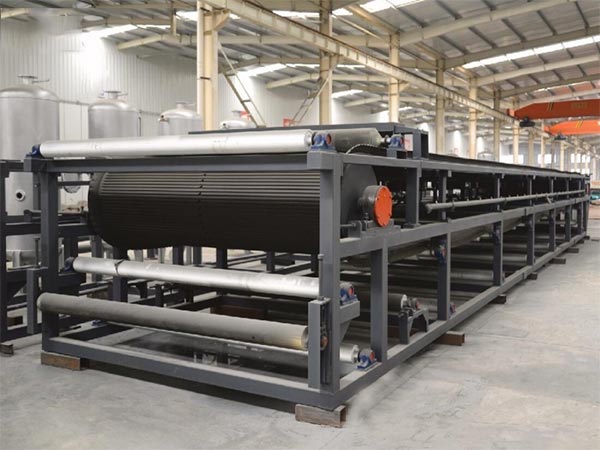
Vacuum pressure is the primary driving force for solid-liquid separation and filter cake dewatering, and it is also the most direct system factor affecting moisture content. A common misunderstanding in field operations is focusing only on whether the static value shown on the vacuum gauge meets the required standard while ignoring the effective vacuum pressure under dynamic production conditions. The vacuum level may appear normal when the equipment is running without material, but once continuous feeding begins, instantaneous vacuum pressure attenuation and fluctuations can occur, becoming a frequent cause of unstable moisture content.
Hidden issues within the vacuum system are often overlooked. Problems such as water accumulation and blockage in the gas-liquid separator, delayed drainage from the vacuum receiver tank, imbalance between gas and water flow in the vacuum pump system, aging and leakage of vacuum pipelines, and scaling or clogging inside pipelines can all prevent the vacuum pressure in the three sections—the filtration zone, washing zone, and drying zone—from remaining stable.
During continuous dewatering, insufficient vacuum pressure and pressure fluctuations in the drying zone prevent free water inside the filter cake from being rapidly removed. Deep capillary water cannot be completely extracted, directly resulting in higher filter cake moisture content and batch-to-batch variations. The key requirement for stable field operation is to ensure that the vacuum pressure in the three independent zones remains stable, without instantaneous pressure drops or air leakage, maintaining a continuous and consistent dewatering driving force.
Vacuum pressure is the primary driving force for solid-liquid separation and filter cake dewatering, and it is also the most direct system factor affecting moisture content. A common misunderstanding in field operations is focusing only on whether the static value shown on the vacuum gauge meets the required standard while ignoring the effective vacuum pressure under dynamic production conditions. The vacuum level may appear normal when the equipment is running without material, but once continuous feeding begins, instantaneous vacuum pressure attenuation and fluctuations can occur, becoming a frequent cause of unstable moisture content.
Hidden issues within the vacuum system are often overlooked. Problems such as water accumulation and blockage in the gas-liquid separator, delayed drainage from the vacuum receiver tank, imbalance between gas and water flow in the vacuum pump system, aging and leakage of vacuum pipelines, and scaling or clogging inside pipelines can all prevent the vacuum pressure in the three sections—the filtration zone, washing zone, and drying zone—from remaining stable.
During continuous dewatering, insufficient vacuum pressure and pressure fluctuations in the drying zone prevent free water inside the filter cake from being rapidly removed. Deep capillary water cannot be completely extracted, directly resulting in higher filter cake moisture content and batch-to-batch variations. The key requirement for stable field operation is to ensure that the vacuum pressure in the three independent zones remains stable, without instantaneous pressure drops or air leakage, maintaining a continuous and consistent dewatering driving force.
3. Filter Cloth Permeability and Regeneration Performance: The Core Medium for Filtration and Dewatering
The filter cloth is the core medium for solid-liquid separation. Its permeability, cleanliness, and suitability directly determine dewatering efficiency and operational stability. During long-term continuous operation, fine particles and colloidal impurities in the material continuously accumulate and become embedded in the filter cloth pores. If the cleaning and regeneration process is insufficient, the filter cloth will gradually become clogged, causing its water permeability and air permeability to decline progressively. As a result, the dewatering performance continues to deteriorate, with the most obvious symptoms being continuously increasing filter cake moisture content and more frequent fluctuations during later operation.
From a practical operation and maintenance perspective, two key aspects require strict control:
First, filter cloth selection and material compatibility. Filter cloths with suitable pore size, air permeability, and material characteristics should be selected according to different feed materials. For fine-particle sludge and chemical slurries, high-density filter cloths with good air permeability are recommended to prevent material leakage and pore blockage.
Second, the stability of the high-pressure washing system. The washing system must ensure sufficient cleaning water pressure, unobstructed spray nozzles, complete coverage, and no dead zones. This ensures that the filter cloth can be thoroughly regenerated during each circulation cycle, maintaining consistent pore permeability.
Localized filter cloth blockage or uneven washing performance can directly cause differences in dewatering efficiency across different areas of the filter belt, resulting in overall fluctuations in filter cake moisture content.
The filter cloth is the core medium for solid-liquid separation. Its permeability, cleanliness, and suitability directly determine dewatering efficiency and operational stability. During long-term continuous operation, fine particles and colloidal impurities in the material continuously accumulate and become embedded in the filter cloth pores. If the cleaning and regeneration process is insufficient, the filter cloth will gradually become clogged, causing its water permeability and air permeability to decline progressively. As a result, the dewatering performance continues to deteriorate, with the most obvious symptoms being continuously increasing filter cake moisture content and more frequent fluctuations during later operation.
From a practical operation and maintenance perspective, two key aspects require strict control:
First, filter cloth selection and material compatibility. Filter cloths with suitable pore size, air permeability, and material characteristics should be selected according to different feed materials. For fine-particle sludge and chemical slurries, high-density filter cloths with good air permeability are recommended to prevent material leakage and pore blockage.
Second, the stability of the high-pressure washing system. The washing system must ensure sufficient cleaning water pressure, unobstructed spray nozzles, complete coverage, and no dead zones. This ensures that the filter cloth can be thoroughly regenerated during each circulation cycle, maintaining consistent pore permeability.
Localized filter cloth blockage or uneven washing performance can directly cause differences in dewatering efficiency across different areas of the filter belt, resulting in overall fluctuations in filter cake moisture content.
4. Belt Speed and Dewatering Residence Time: The Key to Process Parameter Matching
A vacuum belt filter operates in a dynamic continuous processing mode. The effective dewatering residence time of the filter cake in the drying zone is a critical process parameter that determines the final moisture content. The belt speed directly affects the entire process duration, including material forming, dewatering, and drying. Improper parameter matching is a common operational factor causing unstable moisture content in field applications.
When the belt speed is too high, the filter cake forming time is insufficient, resulting in uneven cake thickness. The inner layer of the material may enter the discharge stage before completing the dewatering process, leaving excessive residual moisture inside the filter cake. When the belt speed is too low, the filter cake remains in the vacuum zone for too long. The surface layer may become excessively dry and crack, forming numerous air channels. Vacuum pressure then escapes through these cracks and cannot effectively act on the deeper layers of the filter cake, leading to incomplete dewatering and uneven moisture distribution between the dry and wet layers.
In practical operation, the optimal belt speed must be accurately matched according to material viscosity, particle density, filter cake thickness, and target moisture content. This ensures that the material undergoes sufficient and uniform deep dewatering within the effective vacuum pressure zone.
5. Overall Equipment Sealing System Condition: Eliminating Hidden Vacuum Leakage
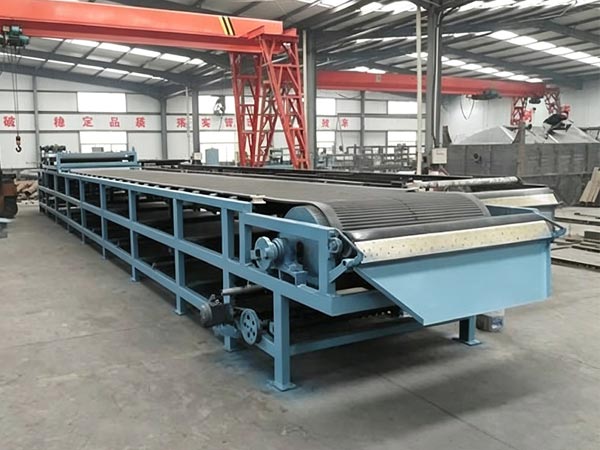
Sealing system failures are one of the most easily overlooked hidden issues during operation and maintenance. Even without obvious liquid leakage or abnormal equipment noise, sealing problems can still cause continuous fluctuations in filter cake moisture content. A Horizontal belt filter relies on a sealed vacuum environment to achieve dewatering. After long-term operation, components such as rubber skirts, vacuum box sealing strips, pipeline connections, and moving vacuum chamber seals may experience wear, aging, deformation, or loosening.
Seal failure allows external air to continuously enter the vacuum system, disrupting the sealed negative pressure environment and causing localized vacuum leakage and uneven vacuum distribution across the dewatering zones. Different areas of the same filter belt may experience inconsistent vacuum levels, resulting in uneven filter cake dewatering performance. This ultimately appears as fluctuating and unstable moisture content over long-term operation.
During routine maintenance, the wear condition of sealing components should be regularly inspected. Aging parts should be replaced in a timely manner to maintain the overall vacuum sealing performance of the equipment and ensure a stable foundation for consistent dewatering performance.
Sealing system failures are one of the most easily overlooked hidden issues during operation and maintenance. Even without obvious liquid leakage or abnormal equipment noise, sealing problems can still cause continuous fluctuations in filter cake moisture content. A Horizontal belt filter relies on a sealed vacuum environment to achieve dewatering. After long-term operation, components such as rubber skirts, vacuum box sealing strips, pipeline connections, and moving vacuum chamber seals may experience wear, aging, deformation, or loosening.
Seal failure allows external air to continuously enter the vacuum system, disrupting the sealed negative pressure environment and causing localized vacuum leakage and uneven vacuum distribution across the dewatering zones. Different areas of the same filter belt may experience inconsistent vacuum levels, resulting in uneven filter cake dewatering performance. This ultimately appears as fluctuating and unstable moisture content over long-term operation.
During routine maintenance, the wear condition of sealing components should be regularly inspected. Aging parts should be replaced in a timely manner to maintain the overall vacuum sealing performance of the equipment and ensure a stable foundation for consistent dewatering performance.
6. Effectiveness of Material Flocculation Pretreatment: Determining Filter Cake Formation Quality
This is a critical control stage that is missing in many production lines and is also an important factor causing unstable filter cake moisture content. When slurry is directly fed into the filtration process without precise flocculation pretreatment, material particles cannot effectively aggregate and form stable flocs. Fine particles remain suspended in the slurry and are more likely to pass through the filter cloth or cause pore blockage during filtration. As a result, the filter cake becomes loose, uneven in thickness, and difficult to dewater effectively.
The dosage of flocculant, dilution concentration, and mixing reaction time directly determine the size, density, and uniformity of flocs. Excessive flocculant dosage can increase slurry viscosity and reduce filter cake permeability; insufficient dosage results in loose flocs and incomplete solid-liquid separation. Uneven mixing can cause oversized flocs in some areas while other areas remain without sufficient floc formation, ultimately leading to significant differences in dewatering performance.
A stable pretreatment process enables the material to form uniform, dense, and permeable flocs, ensuring consistent filter cake formation and providing essential conditions for uniform dewatering and stable moisture content control.
This is a critical control stage that is missing in many production lines and is also an important factor causing unstable filter cake moisture content. When slurry is directly fed into the filtration process without precise flocculation pretreatment, material particles cannot effectively aggregate and form stable flocs. Fine particles remain suspended in the slurry and are more likely to pass through the filter cloth or cause pore blockage during filtration. As a result, the filter cake becomes loose, uneven in thickness, and difficult to dewater effectively.
The dosage of flocculant, dilution concentration, and mixing reaction time directly determine the size, density, and uniformity of flocs. Excessive flocculant dosage can increase slurry viscosity and reduce filter cake permeability; insufficient dosage results in loose flocs and incomplete solid-liquid separation. Uneven mixing can cause oversized flocs in some areas while other areas remain without sufficient floc formation, ultimately leading to significant differences in dewatering performance.
A stable pretreatment process enables the material to form uniform, dense, and permeable flocs, ensuring consistent filter cake formation and providing essential conditions for uniform dewatering and stable moisture content control.
7. Environmental and Material Temperature Conditions: Minor Factors Affecting Dewatering Stability
During long-term continuous production, changes in ambient temperature and material temperature can indirectly affect filter cake moisture content stability, especially in plants with significant seasonal temperature variations. Under low-temperature conditions, slurry viscosity increases, reducing water mobility and permeability. As a result, capillary water inside the filter cake becomes more difficult to remove, and the moisture content will be significantly higher under the same process parameters. Under high-temperature conditions, surface moisture evaporates too quickly, causing the surface layer of the filter cake to dry and crack while the inner layer remains wet, resulting in uneven moisture distribution between the dry and wet layers.
In addition, temperature differences between day and night and changes in workshop ventilation conditions may cause condensation inside equipment pipelines and vacuum tank walls. Even slight water accumulation can affect vacuum pressure stability. Therefore, high-standard continuous dewatering operations require seasonal adjustment of process parameters to accommodate changes in material viscosity, compensate for dewatering deviations caused by environmental factors, and ensure stable moisture content performance throughout the year.
During long-term continuous production, changes in ambient temperature and material temperature can indirectly affect filter cake moisture content stability, especially in plants with significant seasonal temperature variations. Under low-temperature conditions, slurry viscosity increases, reducing water mobility and permeability. As a result, capillary water inside the filter cake becomes more difficult to remove, and the moisture content will be significantly higher under the same process parameters. Under high-temperature conditions, surface moisture evaporates too quickly, causing the surface layer of the filter cake to dry and crack while the inner layer remains wet, resulting in uneven moisture distribution between the dry and wet layers.
In addition, temperature differences between day and night and changes in workshop ventilation conditions may cause condensation inside equipment pipelines and vacuum tank walls. Even slight water accumulation can affect vacuum pressure stability. Therefore, high-standard continuous dewatering operations require seasonal adjustment of process parameters to accommodate changes in material viscosity, compensate for dewatering deviations caused by environmental factors, and ensure stable moisture content performance throughout the year.
Conclusion
The stable control of filter cake moisture content in vacuum belt filters relies on comprehensive process management rather than adjustments to a single parameter. The seven key factors—feed homogenization, vacuum pressure, filter cloth regeneration, process parameter matching, sealing performance, flocculation pretreatment, and environmental adaptation—are closely interconnected. Any deviation in one stage can lead to fluctuations in filter cake moisture content.
In field production, replacing the “blind parameter adjustment” approach with a standardized control system covering the entire process is essential to effectively address issues such as uneven dry and wet filter cake, excessive moisture content, and batch-to-batch variations. This enables stable and consistent continuous dewatering performance, reduces production energy consumption, and improves the overall operating efficiency of the production line.
The stable control of filter cake moisture content in vacuum belt filters relies on comprehensive process management rather than adjustments to a single parameter. The seven key factors—feed homogenization, vacuum pressure, filter cloth regeneration, process parameter matching, sealing performance, flocculation pretreatment, and environmental adaptation—are closely interconnected. Any deviation in one stage can lead to fluctuations in filter cake moisture content.
In field production, replacing the “blind parameter adjustment” approach with a standardized control system covering the entire process is essential to effectively address issues such as uneven dry and wet filter cake, excessive moisture content, and batch-to-batch variations. This enables stable and consistent continuous dewatering performance, reduces production energy consumption, and improves the overall operating efficiency of the production line.