 English
 日本
日本 한국인
한국인 Français
 Deutsch
 español
 Italiano
 Portugal
 Việt Nam
 türkiye
 عرب
عرب Русский
 čeština
 แบบไทย
 Eesti
Eesti Gaeilge
 Hmoob
Hmoob íslenskur
 Cymraeg
 български
 اردو
اردو Polski
 Hrvatski
 українська
 bosanski
 فارسی
فارسی lietuvių
 latviski
 עִברִית
 Română
 Ελληνικά
 dansk
dansk Magyar
 norsk
norsk Suomalainen
 Nederlands
 svenska
 slovenský
 Slovenščina
 हिंदी
हिंदी Indonesia
 Melayu
 Malti
Malti Kreyòl ayisyen
 català
 বাংলা
বাংলা Српски
 o'zbek

Both vacuum drum filters and plate-and-frame filter presses are types of filtration equipment used for solid-liquid separation of various suspensions. However, they differ significantly in terms of structure, operation mode, and filtration performance, which are elaborated on separately below.
Design Core
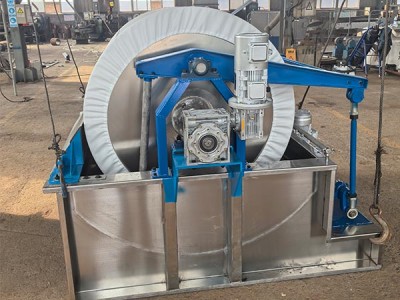
Vacuum Drum Filter
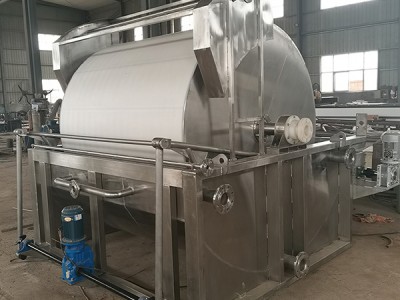
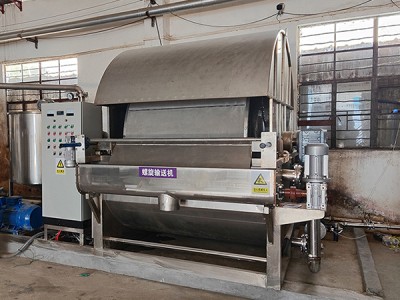
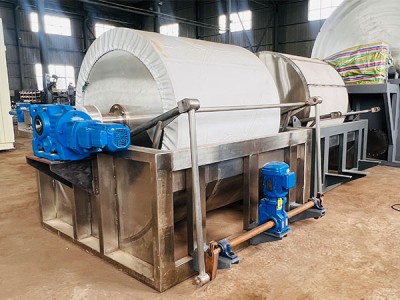
It adopts continuous negative pressure adsorption as its core design philosophy, focusing on the efficient and continuous treatment of low-to-medium concentration suspensions. It is particularly suitable for working conditions with high throughput requirements and highly viscous materials, serving as key equipment for large-scale production in mining, metallurgy, environmental protection and other industries.
It adopts continuous negative pressure adsorption as its core design philosophy, focusing on the efficient and continuous treatment of low-to-medium concentration suspensions. It is particularly suitable for working conditions with high throughput requirements and highly viscous materials, serving as key equipment for large-scale production in mining, metallurgy, environmental protection and other industries.
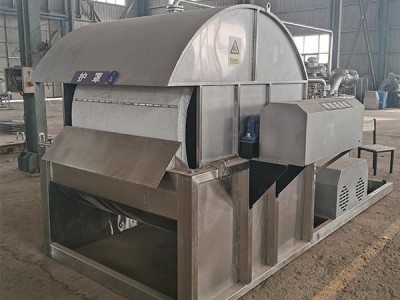
Plate-and-Frame Filter Press
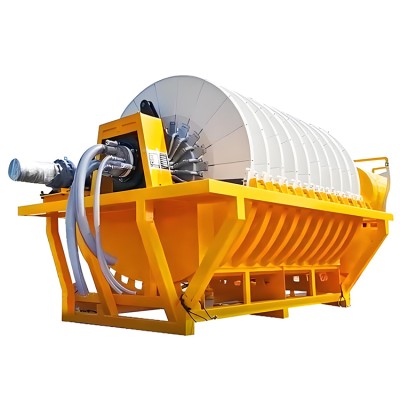
It takes high-pressure extrusion and retention as its core design concept, focusing on the deep dewatering of high-concentration and high-solid-content materials. With the key advantages of low filter cake moisture content and high separation precision, it is widely used in chemical, food, pharmaceutical and other fields with strict requirements for separation purity.
It takes high-pressure extrusion and retention as its core design concept, focusing on the deep dewatering of high-concentration and high-solid-content materials. With the key advantages of low filter cake moisture content and high separation precision, it is widely used in chemical, food, pharmaceutical and other fields with strict requirements for separation purity.
Working Principle
Vacuum Drum Filter
Its working process forms a continuous closed loop: the drum immerses into the slurry tank at a constant speed, and solid particles in the suspension are rapidly adsorbed onto the filter cloth to form a filter cake under the vacuum negative pressure inside the drum. As the drum rotates, the filter cake passes sequentially through the dewatering zone, washing zone, and discharge zone, finally completing solid-liquid separation. The entire process requires no shutdown, realizing automatic continuous operation through vacuum suction and drum rotation. The filter cake moisture content is typically 30%–60%.
Its working process forms a continuous closed loop: the drum immerses into the slurry tank at a constant speed, and solid particles in the suspension are rapidly adsorbed onto the filter cloth to form a filter cake under the vacuum negative pressure inside the drum. As the drum rotates, the filter cake passes sequentially through the dewatering zone, washing zone, and discharge zone, finally completing solid-liquid separation. The entire process requires no shutdown, realizing automatic continuous operation through vacuum suction and drum rotation. The filter cake moisture content is typically 30%–60%.
Plate-and-Frame Filter Press
Its working process is batchwise and cyclical: dozens of filter plates and frames are alternately compressed tightly by a hydraulic system to form sealed filter chambers. Slurry is pumped into the filter chambers under feed pressure, where liquid permeates through the filter cloth and is discharged, while solid particles are trapped to form a filter cake. Once the filter chambers are full of cake, the system stops, depressurizes, and separates the plates and frames. The filter cake is then removed manually or mechanically, completing one full operating cycle.
Thanks to high-pressure squeezing, the filter cake moisture content can be as low as 15%–35%, with separation accuracy significantly higher than that of vacuum drum filters.
Its working process is batchwise and cyclical: dozens of filter plates and frames are alternately compressed tightly by a hydraulic system to form sealed filter chambers. Slurry is pumped into the filter chambers under feed pressure, where liquid permeates through the filter cloth and is discharged, while solid particles are trapped to form a filter cake. Once the filter chambers are full of cake, the system stops, depressurizes, and separates the plates and frames. The filter cake is then removed manually or mechanically, completing one full operating cycle.
Thanks to high-pressure squeezing, the filter cake moisture content can be as low as 15%–35%, with separation accuracy significantly higher than that of vacuum drum filters.
Structure
Vacuum Drum Filter
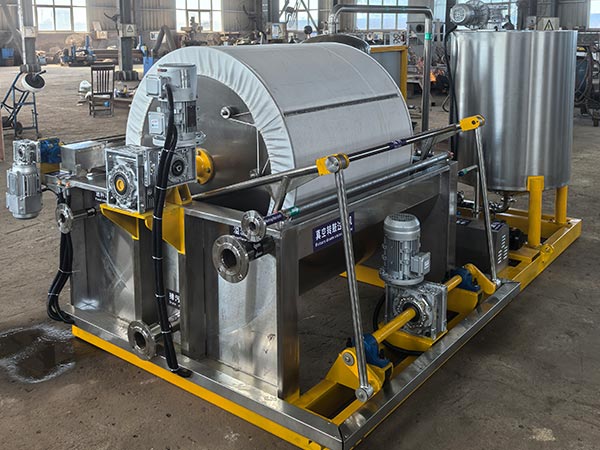
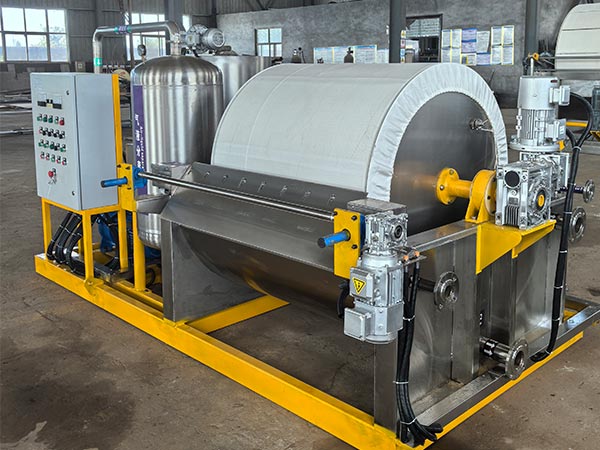
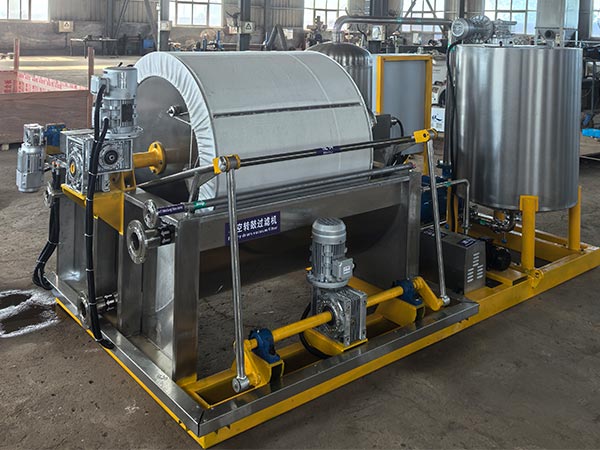
The core structure emphasizes stability during continuous operation:
Main Components:
Drum (mostly stainless steel or rubber-lined carbon steel, diameter 1–5 m, length 1–6 m), vacuum system (including vacuum pump, gas-liquid separator, vacuum piping), slurry tank, washing device, discharge scraper, transmission system (motor + reducer), and filter cloth tensioning mechanism.
Key Design Features:
Filter compartments are evenly distributed on the drum surface. The filter cloth adopts a seamless annular design (materials available: polyester, polypropylene, polyamide) to suit corrosive properties of various materials. The vacuum system must be equipped with a gas-liquid separator to prevent slurry from entering the vacuum pump and affecting operation.
The core structure emphasizes stability during continuous operation:
Main Components:
Drum (mostly stainless steel or rubber-lined carbon steel, diameter 1–5 m, length 1–6 m), vacuum system (including vacuum pump, gas-liquid separator, vacuum piping), slurry tank, washing device, discharge scraper, transmission system (motor + reducer), and filter cloth tensioning mechanism.
Key Design Features:
Filter compartments are evenly distributed on the drum surface. The filter cloth adopts a seamless annular design (materials available: polyester, polypropylene, polyamide) to suit corrosive properties of various materials. The vacuum system must be equipped with a gas-liquid separator to prevent slurry from entering the vacuum pump and affecting operation.
Plate-and-Frame Filter Press
The core structure emphasizes the reliability of high-pressure sealing:
The core structure emphasizes the reliability of high-pressure sealing:
Main Components:
Filter plates (available in cast iron, stainless steel, or polypropylene), filter frames (matching the filter plates to form filter chambers), filter cloths (independently designed for single pieces and sized to fit the plates and frames), hydraulic clamping system (including hydraulic cylinders, power unit, and control system), feed/discharge pipelines, and bottom beams with frame.
Filter plates (available in cast iron, stainless steel, or polypropylene), filter frames (matching the filter plates to form filter chambers), filter cloths (independently designed for single pieces and sized to fit the plates and frames), hydraulic clamping system (including hydraulic cylinders, power unit, and control system), feed/discharge pipelines, and bottom beams with frame.
Key Design Features:
Guide grooves are distributed on the surface of filter plates to ensure rapid liquid discharge. The hydraulic system is equipped with a pressure-holding device to prevent pressure leakage during filtration. Filter cloths require regular disassembly and cleaning, and some models are fitted with automatic plate pulling and automatic cake discharge devices to improve operating efficiency.
Guide grooves are distributed on the surface of filter plates to ensure rapid liquid discharge. The hydraulic system is equipped with a pressure-holding device to prevent pressure leakage during filtration. Filter cloths require regular disassembly and cleaning, and some models are fitted with automatic plate pulling and automatic cake discharge devices to improve operating efficiency.
Scope of Application
Vacuum Drum Filter
The vacuum drum filter is suitable for processing materials with high viscosity, fine suspended particles, and slow filtration speed. Typical examples include mine tailings, alumina, red mud, sludge, etc.
Plate-and-Frame Filter Press
The plate-and-frame filter press is suitable for processing materials with low viscosity, coarse suspended particles, and fast filtration speed. It is widely used in industries such as chemical, food, pharmaceutical, and light textile industries.
The vacuum drum filter is suitable for processing materials with high viscosity, fine suspended particles, and slow filtration speed. Typical examples include mine tailings, alumina, red mud, sludge, etc.
Plate-and-Frame Filter Press
The plate-and-frame filter press is suitable for processing materials with low viscosity, coarse suspended particles, and fast filtration speed. It is widely used in industries such as chemical, food, pharmaceutical, and light textile industries.
Maintenance
| Contrast Dimensions | Vacuum drum filter | Plate and frame filter press |
| Degree of automation | High efficiency (continuous operation, no human intervention required) | Medium to low speed (intermittent operation, some models have automatic plate pulling function) |
| Filtration efficiency | Large processing capacity and high productivity per unit time | Small processing capacity, but high filter cake dewatering efficiency |
| Energy consumption level | Vacuum pumps have high energy consumption (approximately 15-55 kW). | The energy consumption of the hydraulic system plus the feed pump is medium (approximately 5-30 kW). |
| Operation difficulty | Low (Runs automatically after startup, only requires periodic inspection) | (Manual monitoring of pressure, unloading, and cleaning of filter cloth is required) |
| Maintenance focus | 1.Clean the filter cloth regularly (replace every 1-3 months); change the vacuum pump oil and check the seals; 2.lubricate the drum bearings and maintain the transmission system. |
1.Clean the filter cloth frequently (replace every 1-7 days) 2.Troubleshoot hydraulic system leaks and maintain hydraulic cylinders. Clean the filter plate sealing surface to prevent deformation and leakage. |
| Cost of consumable parts | Filter cloth replacement costs are moderate, while vacuum pump spare parts are expensive. | Filter cloth requires frequent replacement (lower cost); filter plates wear easily (moderate replacement cost). |
| Covered area | Larger size (requires space to allow for drum operation) | Smaller (compact vertical/horizontal layout) |
Selection Recommendations
1. For large‑scale continuous production involving highly viscous slurries with fine particles, the vacuum drum filter is the preferred choice.
2. For deep dewatering, low filter cake moisture content, or high separation precision, the plate‑and‑frame filter press is recommended.
3. In terms of operating cost: vacuum drum filters are suitable for long‑term continuous operation, while plate‑and‑frame filter presses are ideal for short‑term, batch production.
4. For space constraints: choose a plate‑and‑frame filter press if space is limited; select a vacuum drum filter when sufficient space is available and high throughput is required.
1. For large‑scale continuous production involving highly viscous slurries with fine particles, the vacuum drum filter is the preferred choice.
2. For deep dewatering, low filter cake moisture content, or high separation precision, the plate‑and‑frame filter press is recommended.
3. In terms of operating cost: vacuum drum filters are suitable for long‑term continuous operation, while plate‑and‑frame filter presses are ideal for short‑term, batch production.
4. For space constraints: choose a plate‑and‑frame filter press if space is limited; select a vacuum drum filter when sufficient space is available and high throughput is required.
Conclusion
In summary, the vacuum drum filter boasts the core advantage of continuous and high-efficiency operation, making it ideal for large-scale processing of highly viscous materials. The plate-and-frame filter press stands out for deep dewatering and high-precision separation, satisfying batch production scenarios with strict purity requirements.
Neither has an absolute advantage over the other; the key lies in matching the material characteristics, capacity demands, site conditions, and operating cost budget of the enterprise. For practical selection, a comprehensive evaluation is recommended based on slurry parameters, production processes, and environmental requirements, with pilot testing to verify separation performance when necessary.
Proper selection of filtration equipment can improve production efficiency, reduce operation and maintenance costs, and provide stable and reliable technical support for industrial solid-liquid separation.
In summary, the vacuum drum filter boasts the core advantage of continuous and high-efficiency operation, making it ideal for large-scale processing of highly viscous materials. The plate-and-frame filter press stands out for deep dewatering and high-precision separation, satisfying batch production scenarios with strict purity requirements.
Neither has an absolute advantage over the other; the key lies in matching the material characteristics, capacity demands, site conditions, and operating cost budget of the enterprise. For practical selection, a comprehensive evaluation is recommended based on slurry parameters, production processes, and environmental requirements, with pilot testing to verify separation performance when necessary.
Proper selection of filtration equipment can improve production efficiency, reduce operation and maintenance costs, and provide stable and reliable technical support for industrial solid-liquid separation.